Loading...
B.C. institutions have cut more than 180 programs and dismissed or laid off more than 1,300 faculty and staffManaging the books at post-secondary institutions in B.C. is getting tougher for many, alth...

KLHIISA
Writer
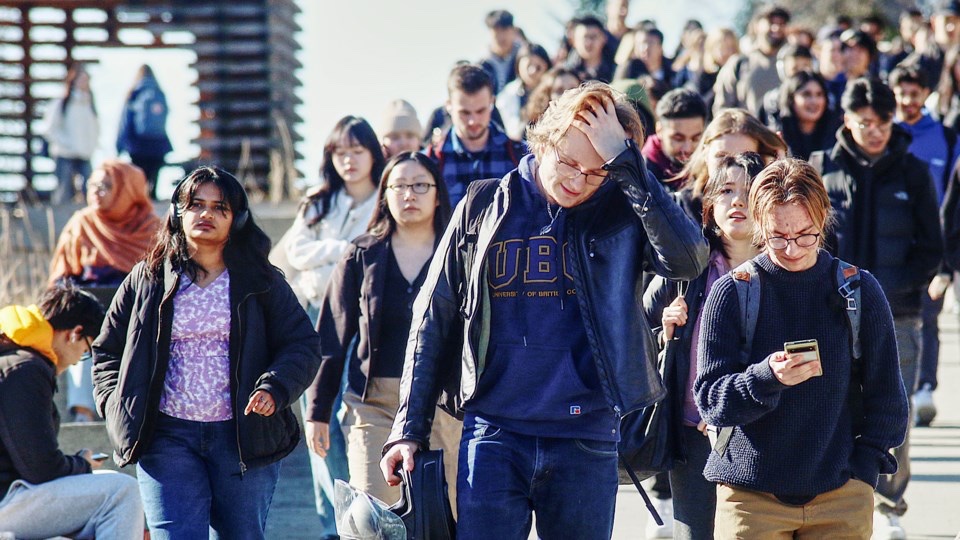
B.C. institutions have cut more than 180 programs and dismissed or laid off more than 1,300 faculty and staff
Managing the books at post-secondary institutions in B.C. is getting tougher for many, although larger institutions cite financial stability and increasing overall enrolment.
B.C. colleges and universities were forced to cut staff and programs following the federal government's January 2024 decision to cap the number of international study permits.
Ottawa explained its aim was to ease pressure on housing, health care and other public services.
It said it would reduce new international student approvals by 35 per cent compared with 2023 levels, and by a further 10 per cent in 2025.
The decline has hit institutional revenue particularly hard because international students in the province pay more than 5.8 times the tuition that Canadian counterparts pay, according to Statistics Canada.
The national stats agency calculated that international students at B.C. post-secondary institutions paid an average $39,851 in the 2025-26 school year, compared with $6,862 paid by the average domestic student.
International students had comprised about 20 per cent of post-secondary students in the province, according to a June report by BC Policy Solutions researcher and policy analyst Veronique Sioufi.
The report found 19 of the province’s 25 public post-secondary institutions forecasted at least one year of operating losses during the next three years.
It cited a B.C. government estimate that the shortfall in revenue to those institutions amounts to approximately $300 million annually.
Sioufi compiled a list of more than 180 programs that B.C.'s colleges and universities have cut since the federal policy went into effect.
She also tallied data showing that those institutions have dismissed or laid off more than 1,300 faculty and staff in the same timeframe.
"This count excludes the likely equal or higher number of contract instructors whose contracts have not been renewed and the hundreds of course sections that have been eliminated," Sioufi told Business in Vancouver.
The federal government's policy shift on international students disproportionately hit B.C. hard, she said.
The province has suffered a 66 per cent decline in its number of federally approved international students: from about 97,000 in 2023 to 32,596 in 2026, Sioufi said.
She said Ottawa’s distribution formula was based on provincial population rather than on existing enrolment, and that B.C. and Ontario, which previously combined to host three-quarters of Canada's international students, only received about one-third of new international-student approvals.
Institutions grapple with uncertainty
Langara College has experienced the largest staffing impact among B.C.’s public post-secondary institutions, according to Sioufi's report.
As of this spring, it had endured 219 "staffing impacts," which include job cuts or layoffs but not contracts that failed to be renewed. Langara also cut or suspended three programs, according to the report.
Langara declined to make anyone available for an interview.
Capilano University was in a high position on the list of institutions that cut programs, with 35 program cuts or suspensions as of early spring, though no staff cuts, according to Sioufi's report.
Vancouver Community College (VCC), in contrast, suffered significant cuts to both staff and programs.
Sioufi's report noted that as of early spring, the institution laid off or dismissed 175 employees and cut or suspended 14 programs.
VCC sent BIV an email saying it faced "significant challenges," due to the federal government's cuts to international student numbers.
"VCC is adjusting its programming to support the college’s long-term sustainability," it stated. "VCC remains committed to serving its students, employees and the broader local community."
bcit_campus020
BCIT is among the many B.C. post-secondary institutions that have suffered a drop in revenue due to the federal government approving fewer international student spaces. | Chung Chow, BIV
The University of the Fraser Valley was also hard hit.
Sioufi's report calculated that by early spring it had 81 "staffing impacts" and 14 program cuts or pauses.
The university then in mid-July released a budget update noting that "international enrolments are lower than projected target estimates."
The silver lining in its report was that "domestic enrolments are aligned to projected target estimates."
The university said in an email that it cannot speculate about future staffing or program decisions.
"The university continues to monitor enrolment and its financial position carefully and will make decisions through its established planning and governance processes," it said.
Large universities, such as the University of British Columbia (UBC) and Simon Fraser University (SFU), are less affected because they have more flexibility in generating cash flow, Sioufi said.
"They have a lot of other funding that they can rely on," she said.
"Colleges and teaching universities can't hold funds over multiple years the way research institutions are allowed to essentially hold funds, invest and hold property and rent that property out. They can operate a little bit more as businesses, whereas the public colleges and teaching universities don't have the ability to do that."
Indeed, UBC and SFU sent BIV emails saying that while the federal government's cap on international students affects them, their operations are stable.
SFU said it implemented administrative budget cuts, a voluntary retirement program, an ongoing hiring freeze and "more than 80 staff position eliminations in 2024 as well as a selective faculty hiring freeze."
Still, it added, "SFU is on solid financial ground."
UBC associate vice-president of communications Kurt Heinrich told BIV his university saw a decline in international enrolment. That prompted strategies such as "curbing discretionary spending, implementing rigorous vacancy management processes, program reviews, restructuring of academic and administrative operations as well as the development and launch of a voluntary retirement program," he said.
A silver lining, he added, was that there has recently been a "positive increase" in overall enrolment and applications.
UBC in the 2025-26 school year welcomed more than 74,000 new and returning students, according to its most recent budget.
Reports go unreleased
The BC NDP government has long sought answers for how best to operate the province’s post-secondary institution sector.
It has commissioned reports to that end but has not yet released them to the public.
In 2022, the NDP hired Don Wright, a former deputy minister to former premier John Horgan, to investigate how to improve the province's funding formula for post-secondary institutions.
Conservative post-secondary education critic Korky Neufeld has been urging the B.C. government to release reports on the sector, which it has commissioned. | Submitted
Conservative post-secondary education critic Korky Neufeld said he has been waiting for that report's release for years.
Then, last November, the B.C. government procured another report, this time by Don Avison, a former deputy minister of education and a former board chair for Emily Carr University, on how to keep the sector sustainable in wake of fewer international students.
The Ministry of Post-Secondary Education and Future Skills confirmed Avison has filed his report.
"We are taking the time to review the findings and determine appropriate next steps," it said in an email. "The Avison report … will be made public once government has finalized its review."
Minister Jessie Sunner is on maternity leave, and unavailable. Interim Minister Jennifer Whiteside was also unavailable for an interview.
Neufeld said he has been asking to see Avison's report for months, but its release date keeps being pushed into the future.
The last he heard was that it could be released this fall.
"I would like to see a commitment to timely reviews of post-secondary education and to make those reports public on a regular basis," he said. "Taxpayers would appreciate that they know where their money is going."
Indeed, the ministry disburses ample cash.
It is set to provide about $3.24 billion in operating grants to B.C.'s 25 public colleges, universities and other institutions in the 2026-27 fiscal year. It also is set to provide $74 million for student services, and $43 million for labour market development, according to the B.C. government's most recent fiscal plan.
The province projected that those 25 public post-secondary institutions' overall expenditures will rise to $9.5 billion in 2028-29 from $9.1 billion in 2025-26.
Sioufi said that those institutions get much of their non-government revenue from students. One problem for these institutions, therefore, is that they have little ability to hike tuition for domestic students.
The B.C. government has capped domestic-student tuition hikes at two per cent per year since 2005.
BIV asked the government if it was considering raising or eliminating the cap on domestic-student tuition hikes.
It sent back an email saying, "The tuition cap is in place and we don't have an update to provide."
Critics have solutions
Neufeld said aside from making reports public, the B.C. government can do several things to improve post-secondary education.
First, he said, the government should tie funding that is earmarked for specific post-secondary institutions to whether those colleges or universities have met desired targets for the number of students they are training in specific fields.
"There's no accountability in the funding to institutions," he said, adding that the government keeps "throwing money at them without any measurables."
He said he has no clear position yet on whether the government should be spending more or less money on post-secondary education but he thinks that the government should have sufficient student data from the schools so they can do necessary calculations to find out.
A separate critique Neufeld has is that the government disproportionately allots approved international student spaces to the province's 25 public post-secondary institutions with few of those spaces going to what he said were about 200 or so independent educational institutions and training centres, such as Sprott Shaw College.
Those independent facilities may provide certificates, pre-university courses or have training for trades—all valuable services, he said.
The province should provide international student spaces to those independent institutions to help them stay in business, Neufeld said.
The province needs skilled workers who come from those independent institutions' training programs, and the international student spaces allotted to those institutions converts into needed revenue, he said.
Those independent institutions also often operate in smaller centres that lack public universities and colleges, he added. That means they are a lifeline for aspiring students in those small communities, Neufeld said.
Finally, he said he would like to see the post-secondary education sector end diversity, equity and inclusion policies.
"It's damaging credibility," he said. "We're hiring people now, not on their merit, but on diversity, equity and inclusion. Now, do we need some of that? Possibly. But that can't be the foundation."
Sioufi has crafted her proposed solutions from a different angle—one that aims to remove free-market economics.
She would like to see what she called a "decolonizing" of post-secondary education.
"Shift away from extractive educational models that position students as customers," she said.
B.C. schools count mounting costs of foreign student decline
Writer
KLHIISA is a registered Non-Profit Organization.