Loading...
The official source before taking the citizenship test has come under fire for the way it deals with Indigenous Peoples. To prepare for his Canadian citizenship test, Stéphane Bazin from France read the federal study guide several times, memorizing facts about hockey players, prime ministers and historical figures. Bazin learned far less, he said, about Indigenous Peoples and their history. “The story in the guide is written by the winners,” said Bazin, 41, who wrote the test and became a citizen three years ago. “It’s a very settler-oriented narrative of the French and the British settling — it’s almost like they arrived in an empty country.”

KLHIISA
Writer
By Ghada Alsharif Toronto Star June 28, 2026
The official source before taking the citizenship test has come under fire for the way it deals with Indigenous Peoples.
To prepare for his Canadian citizenship test, Stéphane Bazin from France read the federal study guide several times, memorizing facts about hockey players, prime ministers and historical figures.
Bazin learned far less, he said, about Indigenous Peoples and their history.
“The story in the guide is written by the winners,” said Bazin, 41, who wrote the test and became a citizen three years ago. “It’s a very settler-oriented narrative of the French and the British settling — it’s almost like they arrived in an empty country.”
Given France’s own colonial past, it was a narrative Bazin said he recognized immediately.
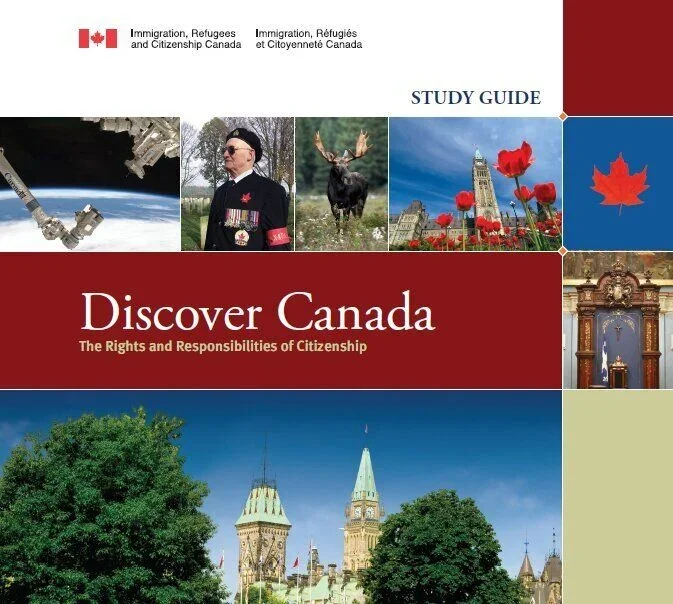
For hundreds of thousands of permanent residents on the path to citizenship each year, the federal government’s study guide — “Discover Canada: The Rights and Responsibilities of Citizenship” — remains the official source for learning about the country’s history and institutions before taking the citizenship test. In many ways, the guide serves as a formal introduction to how Canada understands its own history and to the events, values and ideas it wants newcomers to view as foundational to the country.
Newcomers must correctly answer at least 15 of 20 questions before being invited to take the oath.
But the current version of the guide — created in 2009, with minimal updates in 2012 — contains limited and often outdated information about Indigenous Peoples. It sanitizes early contact with Europeans and Canada’s colonial legacy. Indigenous scholars and advocates say these omissions leave newcomers with an inaccurate understanding of Canada’s past and present.
“It’s pretty shameful,” said Riley Yesno, an Anishinaabe scholar and fellow at the Yellowhead Institute at Toronto Metropolitan University.
“There is a moral and legal obligation to recognize Indigenous Peoples’ history, rather than this grossly misinterpreted version that obscures Canada’s role in ongoing colonization.”
These concerns have continued more than a decade after the Truth and Reconciliation Commission emphasized education about the legacy of the residential school system and Indigenous history in its 94 Calls to Action report, released in 2015.
In Call to Action 93, the commission urged the federal government to “revise the information kit for newcomers to Canada and its citizenship test to reflect a more inclusive history of the diverse Aboriginal peoples of Canada.”
Although the citizenship oath was revised in 2021 to acknowledge Indigenous rights, fulfilling Call to Action 94, the study guide itself has not been updated despite repeated government promises.
In an email, Immigration, Refugees and Citizenship Canada said “the new guide will contain information about the history of the diverse Indigenous Peoples of Canada, and information about the treaties and residential schools.”
The new test will reflect the content of the revised guide, the department said, but it added that it cannot provide more information until it is finalized. No release date has been set for the revised guide, it said.
The department did not directly address inquiries on why there has been a delay but said that it has worked with national Indigenous organizations, historians, academics and others to develop the new guide.
“Any understanding of the history of the nation state of Canada has to incorporate the continued impacts of settler colonialism,” said Phillip Abbott, a sessional faculty member in Indigenous studies at Trent University.
“This guide doesn’t set newcomers up to have a good understanding of that past. It still paints this rosy picture of how Canada came to be.”
What’s in Canada’s citizenship study guide
In the 68-page guide, references to Indigenous Peoples are limited, and the language used to describe that history is often dismissive, Abbott said.
Under a section titled “Canada’s History,” the Discover Canada guide says “large numbers of Aboriginals died of European diseases to which they lacked immunity,” adding that “Aboriginals and Europeans formed strong economic, religious and military bonds in the first 200 years of coexistence which laid the foundations of Canada.”
Residential schools are mentioned in a brief three-sentence passage. The guide notes that the federal government placed Indigenous children in residential schools from the 1800s until the 1980s, “to educate and assimilate them into mainstream Canadian culture.” It says that some were physically abused and that the federal government formally apologized to former students in 2008.
There is no information on the discovery of more than 1,000 suspected unmarked graves at former residential school sites, sexual abuse, or acknowledgment that the last residential school closed in 1996.
Treaties were ‘not always respected’
The guide devotes just two sentences to treaties, stating they “were not always fully respected.”
Abbott said the material largely overlooks land dispossession and the consequences of colonial policies that continue to affect Indigenous communities, including questions surrounding genocide that Ottawa has publicly acknowledged.
The federal government in 2019 said it “accepts” that Canada committed genocide against Indigenous Peoples. The National Inquiry into Missing and Murdered Indigenous Women and Girls’ final report in 2019 concluded that the Canadian government and “colonialist structures” are enabling a genocide.
The Immigration Department in its email did not directly address inquiries on whether the term genocide would be used in the revised guide.
Becoming Canadian means sharing the responsibility of reconciliation and confronting the country’s history with Indigenous Peoples, said George Carothers, senior director of ideas and insights at the Institute for Canadian Citizenship.
“By becoming part of this Canadian family, you are agreeing to share that weight,” Carothers said. “You’re agreeing to say that you’ll recognize the importance of reconciliation.
“But you need truth before reconciliation. It doesn’t help anyone to shy away from the facts.”
Both Carothers and the Yellowhead Institute’s Yesno emphasized that thousands of newcomers are arriving from countries that have their own dark histories of colonial violence.
“I think we owe it to immigrants to recognize that there’s understanding” of that history here, Carothers said.
Omitting those realities, Yesno argued, “helps preserve this image of Canada as less implicated somehow in global imperialism, which in many cases is why people have to immigrate to Canada in the first place.”
Writer
KLHIISA is a registered Non-Profit Organization.