Loading...
If you live in Toronto and don’t have a family doctor, OHIP or insurance, you can likely get medical services at your local community health centre, such as Flemingdon Health Centre and Access Allianc...

KLHIISA
Writer
If you live in Toronto and don’t have a family doctor, OHIP or insurance, you can likely get medical services at your local community health centre, such as Flemingdon Health Centre and Access Alliance.Most community health centres can also help beyond primary care as they work with othercommunity organizations, legal clinics and settlement agencies to help clients with housing, food access, immigration paperwork and more.Making sure that everyone has access to health care is important for communities as a whole, because it’s the cheapest and safest way to ensure everyone is healthy.
“A strong health-care system doesn’t leave anyone behind,” says Laura Guerrero, VP of strategy, infrastructure and transformation at the Flemingdon Health Centre.
But if you don’t have OHIP, private insurance or a ton of money — good luck getting medical care in Toronto.
That’s why Flemingdon Health Centre (FHC) is one of the few community health centres in the city that help uninsured residents access the services they need to stay healthy and safe.
“We know through the OHIP for All campaign years ago that there are at least 500,000 people in Ontario living without OHIP,” Guerrero says, noting that there isn’t exact data. “The issue is that often they fall through the cracks of an immigration system that’s often unfair and hard to navigate. Those are the folks that we serve and that we want to support.”
If you live in Toronto and don’t have a family doctor or insurance, you can likely get help at your local community health centre, usually funded by the Province of Ontario.
Many centres, including FHC, have a catchment area, which is a map of where you can live to be eligible to receive services, as well as specific populations they focus on.
If you live around Flemingdon Park, specifically between Steeles Avenue to the north, Victoria Park Avenue to the east, O’Connor Drive to the south and Laird Drive and Bayview Avenue to the west, you can visit FHC.
You’ll be able to get a family doctor, as well as services for preventative health care, chronic disease monitoring, obstetric and prenatal care, as well as allied health services, which include physiotherapy, dietitian services and social work.
“Essentially, we’re able to provide that kind of wrap-around or holistic care,” says Samyukta Pandalangat, FHC’s manager of primary health care. “We’re able to address more of the social determinants of health with such an interdisciplinary team that’s involved in the care.”
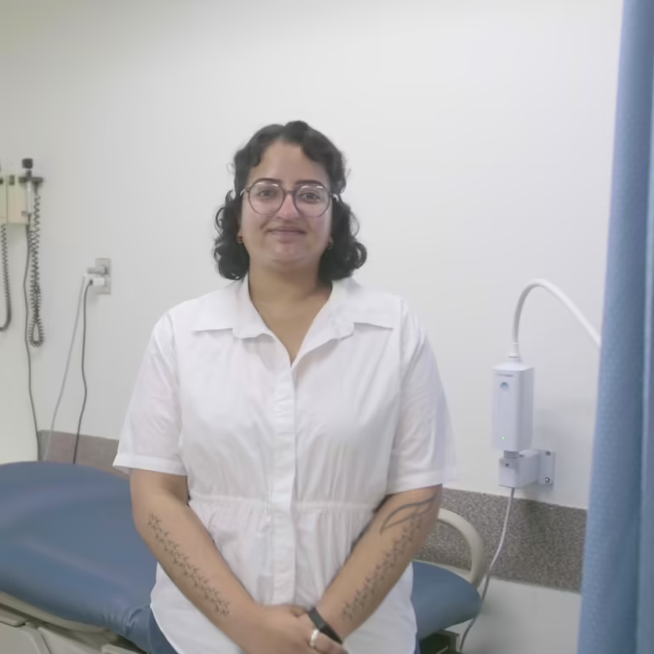
FHC tries to make it as easy as possible for people to sign up. Intake worker Ramsha Khan explains that while the clinic serves both insured and non-insured clients, it prioritizes those with very limited access or facing the greatest barriers to care. Visitors on tourist visas or students are encouraged to explore options like private insurance. “So we can prioritize clients who have no coverage at all or have greater barriers to accessing primary care,” she says.
To register for care at Flemingdon Health Centre:
You can call the intake phone number.Flemingdon Site: 416 429 4991 ext. 280 Fairview Site: 416 640 5298 ext. 280 Health Access Thorncliffe Park Site: 416 4216 369
You can also pass by any of the sites in person, as the clinic currently accepts walk-ins.10 Gateway Blvd. 5 Fairview Mall Dr. Unit #359 45 Overlea Blvd. (in the Thorncliffe Park Community Hub, second floor)
You can also fill out an e-form on FHC’s website to self-register.
If you don’t live in FHC’s catchment area and if you’re a newcomer, immigrant or refugee in the city, you can use Access Alliance’s clinic in downtown Toronto, which welcomes anyone with a postal code that starts with M.
Access Alliance provides settlement services, language services, counselling, therapy and dietitian services to uninsured Torontonians through a no-wait-time clinic. It requires no paperwork, documentation or proof of status.
To register at Access Alliance:
You can call 416 324 9380 to make an appointment.
You can ask reception staff for an intake form at one of these three locations.340 College St. - suite 500 3079 Danforth Ave. 761 Jane St. (second floor)
You can also fill out this e-form.
Other clinics across the city that serve people who don’t have OHIP or insurance include:
Parkdale Queen West Community Health Centre, which has multiple locations.
FCJ Refugee Centre in Oakwood Village.
The Canadian Centre for Refugee and Immigrant HealthCare – Community Volunteer Clinic in Agincourt.
Muslim Welfare Canada in Malvern West.
East End Community Health Centre in Greenwood-Coxwell.
South Riverdale Community Health Centre in South Riverdale.
Stonegate Health Community Centre in Stonegate-Queensway.
You can also find a full list of all community health centres in Ontario here.
Most community health centres can also help beyond primary care. For example, Access Alliance tries to help people who see them get the medication they need or pay for hospitalization and specialized care. However, Bakir says there needs to be a better system-wide approach to funding uninsured care. FHC can connect people to physiotherapists and other services needed for long-term recovery.
Both clinics also work with community organizations, legal clinics and settlement agencies to help clients with housing, food access, immigration paperwork and more.
“More often than not, that’s the pathway for them to finally, after years and decades of emotional and financial drains, get a permanent residence and get OHIP,” Guerrero explains.
Health-care providers that The Green Line spoke to all agree we should provide primary health care to everyone who lives in our city. It’s the right thing to do, and it’s the cheapest and safest way to ensure everyone in the local community is healthy.
“Health is individual, but health care is collective,” Guerrero says. She explains that FHC serves people who have fallen through the cracks of the immigration system, left with no papers and often facing serious financial challenges.
“Most of them are not tourists. They’re not here on a visa or in a particular status. They’re our neighbours that have made Canada home for years, sometimes decades. They have family there in our schools. They’re in our workplaces,” she says, adding that one sick person can affect a whole community around them.
Guerrero thinks back to Ontario’s response to the beginning of the COVID-19 pandemic.
“As a province, we removed barriers to medically necessary care, because we understood something very simple: when one person can’t access health care, all of us become more vulnerable. Illness doesn’t stop with one person. It affects families, school, workplaces and entire communities,” she explains.
Pandalangat also stresses that access to health care is especially important in preventative medicine. When everyone in a community is vaccinated, the community at large is better protected.
“It’s important because it’s not only about the person who can’t have access to health care. It’s about the whole society and the whole community,” says Hossam Bakir, acting director of primary care at Access Alliance.
“This is everybody’s problem. Because if somebody doesn’t have insurance, they will have to run to the E.R., for example, to get urgent services. So the whole system gets blocked and gets delayed because certain services are not offered to certain people,” he says.
At FHC, the cost of providing comprehensive primary care to one person for a full year is $650. One emergency room visit in Toronto can cost $800 without OHIP, and you can get billed thousands of dollars if you end up being hospitalized.
“It’s not only the smarter thing to do. It’s also the least expensive thing to do for all of us,” Guerrero adds.
If you want to help your uninsured neighbours and friends access health care, there are a few things you can do:
Let them know about the services offered in community health centres. Most newcomers might not be aware or hesitate to seek support out of fear for their status or stigma accessing care. Having community-based health ambassadors helps people build trust with health-care providers and encourages them to access their services.
Volunteer with local community health centres. Each centre is run by a volunteer board that determines its mandate and focus. You can also often join community programs and events, whether that’s art therapy, promoting active lifestyles or more. You can check FHC’s volunteer page here and Access Alliance’s volunteer page here.
If you’re a student, both clinics have summer placement programs that you can explore.
Writer
KLHIISA is a registered Non-Profit Organization.