Loading...
For weeks this summer, Gurpreet Singh had joined other international students for a round-the-clock protest in Calgary over the bulk refusals of their post-graduation work permits by the Immigration D...

KLHIISA
Writer
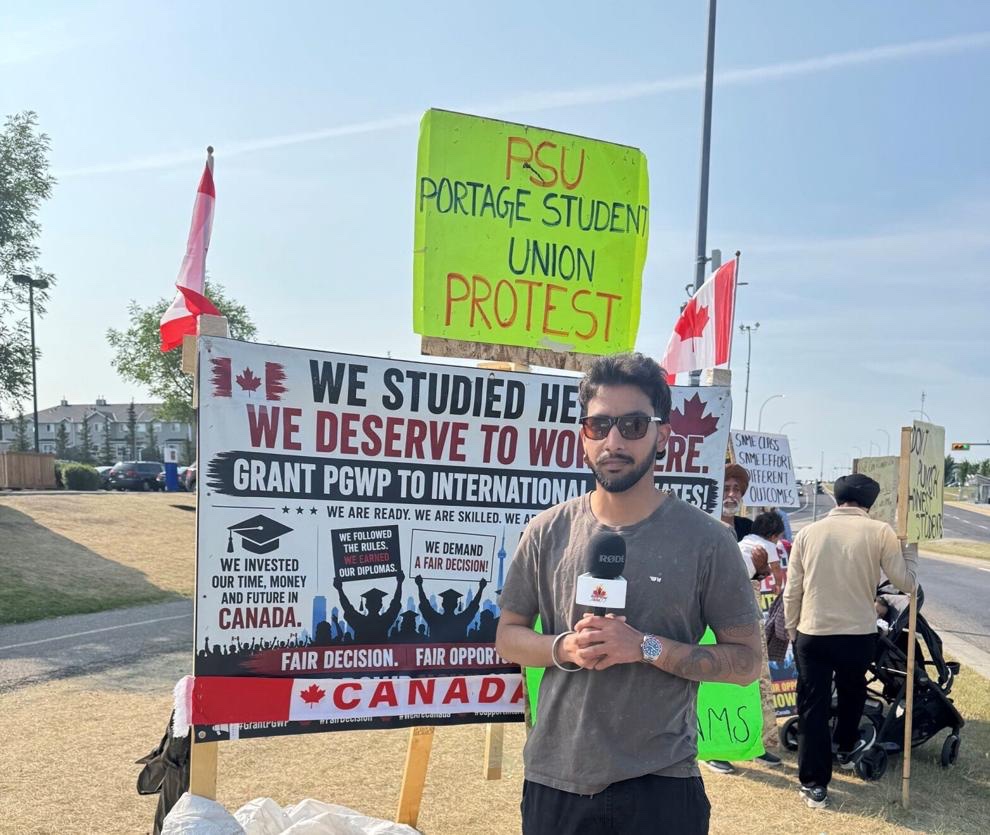
For weeks this summer, Gurpreet Singh had joined other international students for a round-the-clock protest in Calgary over the bulk refusals of their post-graduation work permits by the Immigration Department.
With protest signs erected on the lawn, the students took turns demonstrating across from their alma mater, the Canadian Institute of Osteopathic Therapy (CIOT), where they graduated from the private college’s joint programs licensed by its public partner, Portage College.
Singh didn’t anticipate their peaceful demonstration would bring out the Canada Border Services Agency (CBSA) and land him — and nine other students — an exclusion order that forces them to leave the country and bans them from returning.
“They did it to sabotage our protest,” said the 29-year-old man, who came here from India on a study permit in 2023 and was refused a work permit in early July because graduates from “non-credit” programs like CIOT-Portage’s are no longer eligible under the rules updated a month earlier by the Immigration Department.
“They are successful in stopping our protest because all the students are afraid now. Nobody is coming out. Everyone is scared CBSA officers would be out there waiting for them.”
The right to protest without fear
Advocates say they are alarmed by the pushback of immigration authorities against migrants trying to exercise their right to protest.
International graduates protesting near Portage College in Calgary
International graduates protest near the Canadian Institute of Osteopathic Therapy in Calgary after hundreds of them had their work permit applications refused.
On Wednesday, they delivered an open letter to Prime Minister Mark Carney, Public Safety Minister Gary Anandasangaree, Immigration Minister Lena Metlege Diab and Alberta Premier Danielle Smith, demanding an independent investigation into the incident and clear rules to ensure protest won’t trigger immigration enforcement.
It also urges authorities to withdraw the exclusion orders against 10 of the students.
“Freedom of expression and peaceful assembly are fundamental Charter-protected rights,” said the letter, endorsed by more than 250 civil liberties, human rights, labour, faith, environmental, migrant, refugee and community groups across the country.
“They do not belong only to Canadian citizens or permanent residents. Migrants must be able to speak out, organize and protest without those activities becoming a pathway to immigration enforcement.”
The border agency said it was contacted by Calgary Police Service on Aug. 12, requesting a status check on four individuals at a student protest. Upon confirmation that two of the people were non-compliant with their immigration status, CBSA arrived at the scene and conducted further investigation.
In total, 20 individuals had their status verified, with 12 individuals identified as being “possibly inadmissible” and being asked to attend followup interviews. Advocates said 10 of them have since been issued exclusion orders.
“Inland investigations are an important tool to identify those who should not be in the country and are critical to ensuring compliance with the law,” the CBSA said in an email. “Foreign nationals admitted into Canada are not able to work or study unless authorized and are expected to depart Canada at the end of their authorized period of stay.”
The agency said it’s aware of and reviewing the open letter and its demands, and that “the freedom of peaceful assembly is a Charter-protected right.”
Syed Hussan of the Migrant Rights Network said border agents are used to raid targeted places such as malls, schools and shelters for immigration enforcement but these operations have become less frequent in recent years.
“What happened on Aug. 12th is incredibly dangerous,” said Hussan, whose organization led the advocacy effort for the CIOT-Portage students.
“It hearkens to the use of (U.S. President) Trump-style targeting of people for speaking up for their rights. It’s completely outside the rules. A protest where you are speaking up for justice should be a place where you get justice, not immigration enforcement.”
In an email, Alberta’s Jobs and Immigration Minister Joseph Schow said anyone who comes to Canada on temporary status needs to return home once their permit is expired.
“That is the position of our government, and it’s not going to change,” said Schow, adding that the province supports police and border officials in law enforcement.
Work permits denied for ‘non-credit’ programs
Hussan said about 1,500 international graduates from the CIOT-Portage programs were denied work permits after the Immigration Department quietly tweaked the rules in June.
The affected students, he said, had been informed when they enrolled in these programs that they would be eligible for a work permit upon graduation. Portage College also told CBC News last month that it’s the school’s understanding that students enrolled in non-credit public-private partnership programs prior to May 15, 2024 would qualify, “consistent with the information available at the time and the way these applications had historically been administered.”
“The term non-credit had never appeared in any immigration publication” as a criteria for postgraduation work permit, said Hussan.
Singh, who has a bachelor’s degree in English literature from India, said he first studied organizational management at the joint Cambrian-Hanson College partnership program in Brampton before moving to Calgary. He graduated from the administrative professional certificate program at CIOT in December 2024 and applied for a postgraduation work permit.
He said the refusal came as a shock after an 18-month wait, while he continued working at a gas station and later at a concrete plant, on maintained status. He quit working immediately after he lost his work authorization on July 9.
“I completed my study and they only displayed the non-credit criteria on its website months later,” said Singh, whose parents spent a total $36,000 on his tuition fees in Canada. “It’s just not fair.”
He said he had a pending challenge of the work permit refusal before the Federal Court and was weighing his options during the 90-day grace period to restore his temporary status when CBSA issued him the exclusion order. Many refused students had been accepted by other schools and applied for a new study permit to successfully extend their status, he added.
“I didn’t have time to do that and now I can’t do anything and must leave Canada,” lamented Singh, who has used up his savings on legal fees and is surviving on community support through crowdfunding. He is required to report to CBSA once every two weeks and confirm his exit.
The Immigration Department said there have been no changes to the eligibility criteria for post-graduation work permit, and officials only updated its webpage to “clarify” the rules related to non-credit programs of study.
“Canada supports the right to peaceful protest, freedom of expression and freedom of assembly,” it said in an email. It didn’t address the students’ and advocacy groups’ demands.
Julia Sande, a lawyer with Amnesty International Canada, said she was appalled by the CBSA’s crackdown at the student protest in Calgary, warning that targeting peaceful protests strikes fear and makes people think twice about speaking out.
“It’s intimidation, pure and simple,” said Sande, whose organization endorses the open letter to Carney, Diab, Anandasangaree and Smith.
“Things like freedom of speech, peaceful assembly and the right to protest extend to everyone in Canada. I cannot see how this is seen as relevant or justified to be checking people’s immigration status. It has no bearing on whether they’re allowed to protest.”
Writer
KLHIISA is a registered Non-Profit Organization.