Loading...
The new “Indian problem”Over the August long weekend in Alberta, a banner appeared on a fence northwest of Edmonton, proclaiming “The Indians have done nothing in 100 years and now they wanna tell us ...

KLHIISA
Writer
The new “Indian problem”
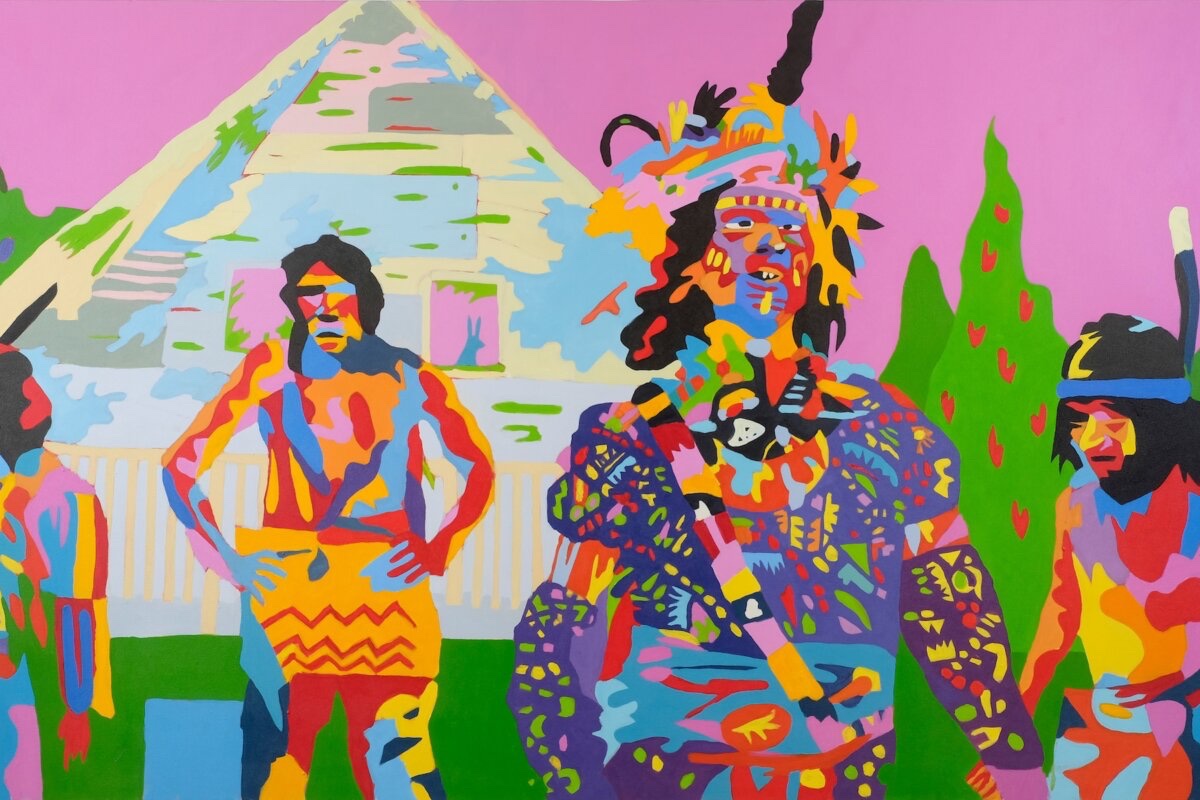
Over the August long weekend in Alberta, a banner appeared on a fence northwest of Edmonton, proclaiming “The Indians have done nothing in 100 years and now they wanna tell us how to run Alberta.” No one was sure who put it up—a local separatist group contacted by APTN denied responsibility—or which “Indians” were supposedly giving the province unwanted advice. But the sentiment was clear, and emblematic of current attitudes toward Indigenous people across this country.
A decade ago, in the salad days of Justin Trudeau’s reign, truth and reconciliation were embraced as a necessary step toward a brighter future; understanding Canada’s shameful treatment of Indigenous people was key to addressing the persistent inequities facing First Nations, Métis, and Inuit communities. In 2021, there was a global outpouring of grief as several communities, beginning with Tḱemlúps te Secwépemc, announced they had identified hundreds of probable graves at former residential school sites. A new federal holiday was created to honour residential school survivors; Canadians bought orange shirts and began acknowledging that “every child matters.”
But today, many Canadians feel the pendulum has swung too far; acknowledgement of residential school history is one thing, but concrete measures to address injustices are quite another. It seems many Canadians believed residential schools were the only federal crime to atone for, perhaps because we don’t have a holiday commemorating illegal land expropriation or underpayment of treaty annuities.
Of course, there have always been Canadians who bristle at Indigenous people exercising their legal rights, but a wider shift is underway. A combination of factors—the flagging economy, the brain-rotting fumes of disinformation permeating social media, rising extremism in Canadian politics—are tipping the scales when it comes to public discourse on Indigenous issues. Many Canadians are aggrieved and anxious, and everywhere they look, they see reasons to blame Indigenous people for their problems. There’s a sense that the sputtering national project of reconciliation has taken something away from them and that Indigenous rights must be quashed to restore their sense of security and prosperity.
“I want to get rid of the Indian problem,” Duncan Campbell Scott, deputy superintendent of the Department of Indian Affairs, said in 1920. “I do not think, as a matter of fact, that this country ought to continuously protect a class of people who are able to stand alone.” To accomplish this goal, he amended the Indian Act to make residential schools compulsory for First Nations children, to permit forced enfranchisement of First Nations, and, later, to bar First Nations from hiring lawyers or filing land claims. Scott believed, fervently, that Canada would be improved by dissolving everything that made Indigenous people distinct: their languages, cultures, laws, customs, beliefs. But his fixation on Indigenous people went beyond their supposed threat to national unity and prosperity. In 1921, he wrote a letter complaining about dancing on reserves, writing “they should not be allowed to dissipate their energies and abandon themselves to demoralizing amusements.”
More than a century later, many Canadians share Scott’s passion for getting mad about whatever Indigenous people are doing, no matter how little it affects them. Every court victory or assertion of constitutional rights—even for harvesting, fishing, or ceremony—is met with alarm and fury, perhaps none more than Cowichan Tribes v. Canada, commonly known as the Cowichan decision. This landmark 2025 victory in the Supreme Court of British Columbia for the Cowichan Nation affirmed their title over a former village site on what is now privately owned land in Richmond, just outside Vancouver. The ruling acknowledged this title coexists with fee simple ownership—as it does in Haida Gwaii where Haida title overlaps with private properties under the “Rising Tide” agreement signed in 2024—and sparked a panic, with Richmond mayor Malcolm Brodie calling it “absolutely devastating.”
The Cowichan Nation has repeatedly emphasized that this court case was about the government’s obligation to address its illegal seizure of their village site and that they do not intend to seek any claims over private properties. And still, Canadians across the country, their panic fuelled by opportunistic media outlets and politicians, are characterizing the ruling as the terrifying vanguard of an approaching Indigenous siege on property rights.
Widespread ignorance is easy to weaponize: on August 10, the BC Conservatives released a statement claiming public assets, including lands occupied by Royal Roads University on Vancouver Island, were being transferred to First Nations in “secret deals,” and renewed their calls to repeal the province’s 2019 adoption of the United Nations Declaration on the Rights of Indigenous Peoples (DRIPA). “The lack of public consultation and oversight on the land file is shocking,” said MLA Scott McInnis in the statement. But in reality, the agreement between Royal Roads University and the Songhees Nation predates DRIPA (“This is good news,” the university president said at a press conference in 2018, according to the Times Colonist), and is part of a decades-long treaty negotiation which has included public consultations regarding land since 2023.
That panic over land claims has turned to blame, even for declining property values. In one example from coastal BC, waterfront property owners who have unauthorized private docks say they are being victimized by “reconciliation policies”; their GoFundMe has raised over a quarter-million dollars to try and overturn provincial legislation affirming Indigenous rights.
Home ownership is arguably Canada’s most sacred cultural value, so a perceived threat to the status quo is seen as an attack on the economic and cultural foundation of the nation itself. But no act is too small to prompt outrage. Recently, a friend sent me a Facebook post for a community celebration hosted by his First Nation, with a comment underneath that sums up this position: “Hate natives more than ever. Never had a problem with them until reconciliation.”
It’s an anxious time in Canada, compared to 2017, when the economy was thriving, jobs were abundant, and the country was eager to distance itself politically and socially from a country that had recently elected Donald Trump for the first time. Like lipstick and hemlines, anti-Indigenous racism is also a kind of recession indicator, tied to perceptions of financial insecurity among Canadians who are less tolerant of Indigenous progress when they feel their own socioeconomic position slipping.
But that’s not the only change. In the past decade, the internet has transformed too: social media is now overflowing with AI slop and disinformation; Elon Musk, owner of X, frequently posts white supremacist content, which sets the tone for the platform; Meta, which owns Facebook and Instagram, has banned users in Canada from seeing news on their platforms since 2023. Conditions have been primed for fomenting disinformation and discrimination, and Indigenous people are not the only targets. Anti-immigration sentiments are also surging, and hate crimes against Jewish and Muslim communities have spiked in recent years.
Still, many Canadians, who may have experienced sadness and guilt when they learned details of the abuse, neglect, and death at residential schools, are also eager to believe they have nothing to feel bad about—that Indigenous people are just trying to make them feel guilty to seize money and power. Canadian American editor David Frum claimed in a column in The Atlantic that land acknowledgements paved the way for the Cowichan decision, writing, “Canadian courts are reinterpreting these rote confessions of historical guilt as legally enforceable admissions of wrongful possession.”
This is the emotional motivation underpinning residential school denialism, a conspiracy theory centring on the potential graves identified in 2021 at the former Kamloops Indian Residential School which have not been exhumed. These conspiracists conveniently ignore the overwhelming volume of evidence for deaths at residential schools—marked graves of children at many former sites, the work of nations, like Cowessess, to successfully identify individuals buried in unmarked graves, the records of the federal government and Catholic Church—to allege that the whole history of these institutions is a scam.
Perpetuating these conspiracy theories and fomenting panic over land claims has become a cottage industry for a handful of politicians and public figures who have carved out a living from stoking outrage. Just look at the Conservative Party of BC’s leadership race last spring. Caroline Elliott ran to be leader after gaining attention for her posts about temporary park closures led by First Nations. Kerry-Lynne Findlay, during a leadership debate, accused Peter Milobar, MLA for Kamloops Centre, of having a conflict of interest because his wife is from the Tr’ondëk Hwëch’in First Nation in the Yukon and worked for the Tḱemlúps te Secwépemc band office. Milobar’s response was not to decry Findlay’s comment as racist; instead, the MLA defended his track record of “voting against lots of Indigenous issues.” Despite—or because—of her comments, Findlay won the leadership vote.
Sane Canadians, even many of those who resent what they see as an overreach of Indigenous rights, recognize these stunts as unhinged. But the other problem is that the theory underlying those stunts—reconciliation opening the floodgates of Indigenous rights claims—is wrong. “The Cowichan decision is an extreme but logical extension of an unresisted political revolution,” Frum wrote. “Among many Canadians in positions of influence, an idea has taken hold that Canada’s founding was a great crime that must be atoned for.” Forcible assimilation and cultural genocide are real horrors that Canadians should reckon with. But reconciliation, that misguided and floundering federal initiative, has nothing to do with court decisions like Cowichan or any of the other landmark court cases that have upheld Indigenous rights.
Long before reconciliation became a buzzword, courts were ruling in favour of Indigenous rights. In 1973, the three judges of the Supreme Court of Canada voted in favour of Frank Calder from the Nisga’a Nation, acknowledging the existence of Aboriginal title. While the case was ultimately dismissed on a technicality, the recognition by some in the highest court in Canada was a milestone. Today, the courts are not trying to wokely atone for hurt feelings over past crimes; they are validating the legal agreements made between Indigenous people and the Crown over the past 300 years.
Since then, those agreements have been neglected, stalled, or outright broken by successive Canadian governments. The Cowichan Nation first petitioned for acknowledgement of their title in 1909; it took another 116 years for the courts to recognize it. Many Canadians seem angry that Indigenous nations are now collecting on debts first incurred over a century ago. But even if the Canadian government tears up UNDRIP, it can’t erase this country’s history and treaties with Indigenous people, which underpin the decisions of courts. The victories that Indigenous nations have won will keep on coming; federal, provincial, and territorial governments know that, which is why, in recent years, they have made the strategic decision to negotiate rather than fight it out in court. The latter is simply an expensive way to keep losing.
Acknowledging that reality—that no matter what people feel about reconciliation and how far they think it’s gone, Canada still has obligations and debts to Indigenous people—is politically unpopular these days. It’s in the interests of politicians, particularly those angling for power, to suggest that they could wipe the slate clean and erase the Indian problem once and for all—to put Indigenous people back in their place and white Canadians back on top.
But the truth is, politicians don’t actually want to do that, because without Indigenous people as a scapegoat for every economic and social woe facing this country—declining property values, overburdened health care systems, crushing bureaucracy, petty crime—it would become obvious that the blame, rather, lies with those same politicians.
Ihave lost count of how many times someone has told me it’s unfair that many First Nations students have their university tuition paid by their communities; they seem to think the solution to high tuition costs is Indigenous governments defunding education initiatives, and not their own government willfully allowing higher education to become financially out of reach for many Canadians. Those who criticize Indigenous nations suing to protect their territories from industrial pollution and environmental degradation seem willing to believe that they, personally, would benefit more from a privately owned mine or pipeline than cleaner air and water, which are perhaps the only forms of wealth that actually do trickle down.
The same logic extends to every attack on Indigenous life: if Canadians don’t expect their leaders to make things better for them, at least they can demand that everyone else suffer at least as badly. It’s a philosophy of impoverishment, intellectually and morally. Under such a belief system, any victory for Indigenous people—no matter how little it affects the actual lives of Canadians—is intolerable.
Turning us from First Nations back into Indians is the only balm for such ideological suffering. But even that won’t help. Canada has tried again and again to suppress Indigenous rights and erase Indigenous people, and every time it has failed. Its odds of success seem considerably smaller now than they did a century ago, but if we disappeared tomorrow, Canadians would be left with all the same problems they have now. Maybe it’s time to start directing that anger where it belongs.
Writer
KLHIISA is a registered Non-Profit Organization.