Loading...
Sukhmani Kaur did everything she thought she was supposed to do. The student from India completed a two-year business management program at a Calgary college, graduated and applied for a work per...

KLHIISA
Writer
Sukhmani Kaur did everything she thought she was supposed to do.
The student from India completed a two-year business management program at a Calgary college, graduated and applied for a work permit — only to be turned down for a reason she never saw coming.
Kaur was rejected not because of a 2024 federal crackdown on private-public college arrangements, which she had already confirmed didn’t apply to her. She was denied because Ottawa considered her diploma “non-credit” — essentially classifying it alongside general interest or hobby courses, making her ineligible for a post-graduation work permit.
That rule was not clearly spelled out when she started her program in 2023 at the Canadian Institute of Osteopathic Therapy (CIOT), which partnered with Portage College, a public institution. In fact, there was no mention that graduates of non-credit programs would be ineligible for the coveted work permit.
But on June 24 of this year, the Immigration Department quietly updated its website, saying the change was meant to “clarify the existing eligibility requirements related to non-credit programs of study” — not to introduce a new rule.
Since then, several hundred graduates from three different diploma programs under the joint CIOT-Portage partnership have had their work permit applications refused.
Immigration experts said work permit refusals based on non-credit programs are a “brand new phenomenon,” and they won’t be surprised if officials are going to pursue graduates from similar programs at other Canadian schools through the new “non-credit” lens when assessing their applications.
“There’s no reason why Portage is special,” said Toronto immigration lawyer Amir Zarei, who is assisting some of the refused applicants from Portage.
“There are other non-credit programs being offered through private-public partnerships in other provinces. This opens the door for Immigration to just go after students graduating from those colleges as well and it can have a very large impact.”
Government says update was to ‘clarify’ criteria
In 2024, Ottawa made drastic changes to the international student program amid a public backlash against the soaring temporary resident population, in part by restricting access to the coveted postgraduation work permits.
International graduates must meet new language proficiency requirements and those completing public college diploma programs will only be eligible for postgraduation work permits if their field of study is linked to labour market shortages in Canada.
According to data obtained recently by Vancouver immigration lawyer Steven Meurrens, the approval rate for postgraduate work permits has dropped by 8 percentage points from 87 per cent in 2023 to 79 per cent as of November 2025.
The Immigration Department said there have been no changes to the eligibility criteria for the post-graduation work permit (PGWP) program, and the website was updated just to “clarify” the existing rules involving non-credit programs.
“To be eligible for a PGWP, applicants must complete a program of study that leads to a degree, diploma, or certificate from a designated learning institution,” it explained in an email. “This long-standing requirement does not include general interest programs, ESL/FSL programs, and other types of non-credit programs.”
The department said it does not track data specific to non-credit study programs and therefore couldn’t provide the number of postgraduation work permit refusals based on this ground.
In a response to the Star’s inquiry, Portage College said it started working with CIOT in 2023 but no further student intakes were admitted after May 2024. Since then, they have taught students to completion of their programs and the curriculum licensing agreement has ended.
The school said it recognizes some graduates have been affected by recent postgraduation work permit decisions and understands the stress and uncertainty they face. However, it pointed out that these decisions are made solely by the Immigration Department.
“Portage College has no involvement in the review, assessment, or determination of individual immigration applications,” said the administration, encouraging graduates with questions to seek advice from licensed immigration lawyers and consultants.
Graduates decry ‘unfair’ refusals
Calgary immigration consultant Mandeep Lidher, who represents some refused work permit applicants, said the affected students were all enrolled in three programs — teacher’s assistant, business management and administrative professional diplomas.
He said the completion of a “non-credit program of study” did not exist anywhere in the immigration legislation, regulations, policies or publicly available eligibility guidance as a stand-alone ground of ineligibility before the department’s June update.
“The criterion appears to be entirely new,” said Lidher. “It is now being applied to pending applications from students who enrolled and began these programs years earlier under a different published eligibility framework.”
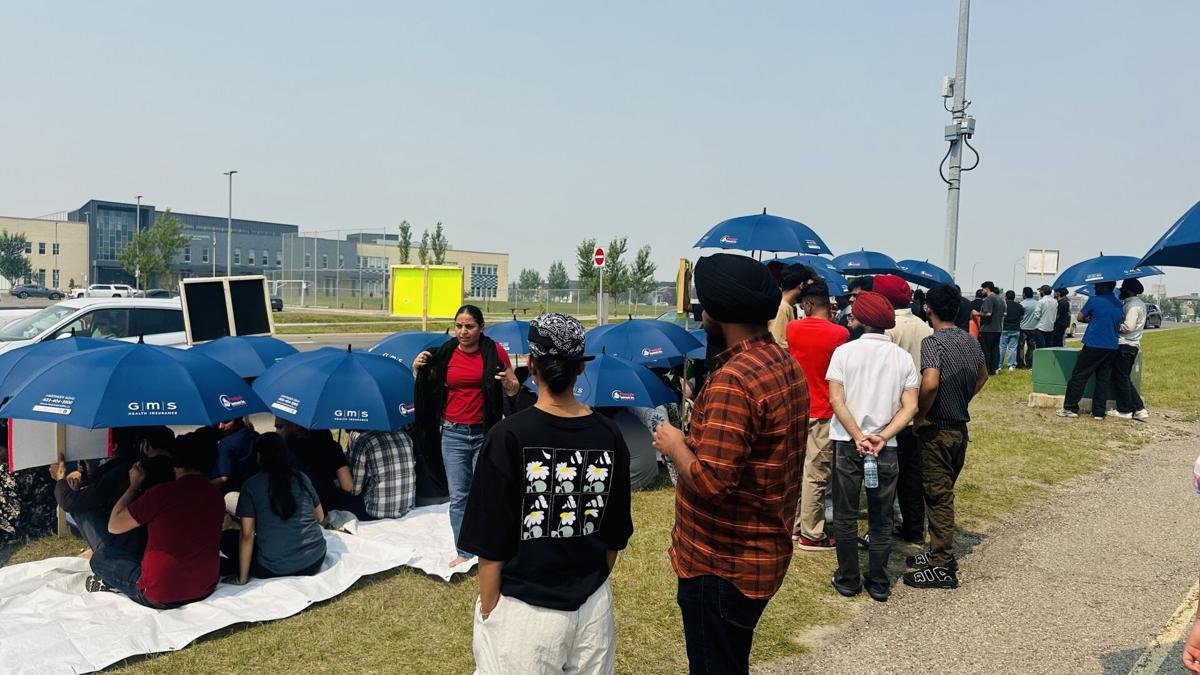
Sikander Singh, a Portage student organizer, said so far about 500 students have had work permits refused but the number is climbing as many applications are pending. Since last week, refused applicants have staged ongoing protests near Portage’s campus in downtown Calgary.
“The refusal is unfair,” said the 29-year-old, who came here from India on a study permit in 2022 and graduated from the administrative professional diploma program two years ago. His work permit application has been pending since.
“We met the guidelines of the college. We met the guidelines of the Immigration Department. They said those students who enrolled before May 15, 2024 in the courses would be eligible … All the criteria were under the grandfather rule.”
Zarei, the Toronto lawyer, said the students followed the rules and had the legitimate expectation that they would receive their work permits based on the department’s guidelines at the time. He recommends refused applicants to first submit a reconsideration request to Immigration, cautioning that they only have 15 days to file a judicial review to the Federal Court from the date of the refusal decision.
Kaur said she had to quit her job on the floor at a warehouse immediately after her application was rejected on July 8, and now must fork out thousands of dollars for legal fees.
“We have done nothing wrong,” said the 27-year-old. “But we are paying for all of that for no reasons.”
Why hundreds of international students are suddenly being denied Canadian work permits: ‘We have done nothing wrong’
Writer
KLHIISA is a registered Non-Profit Organization.